
Case Study—Accessibility and Compliance
Get the Conversation Going
Northbeam · Reconstruction · Fictional Brand
<5 sec
Conversation start (OKR, hit in user research)
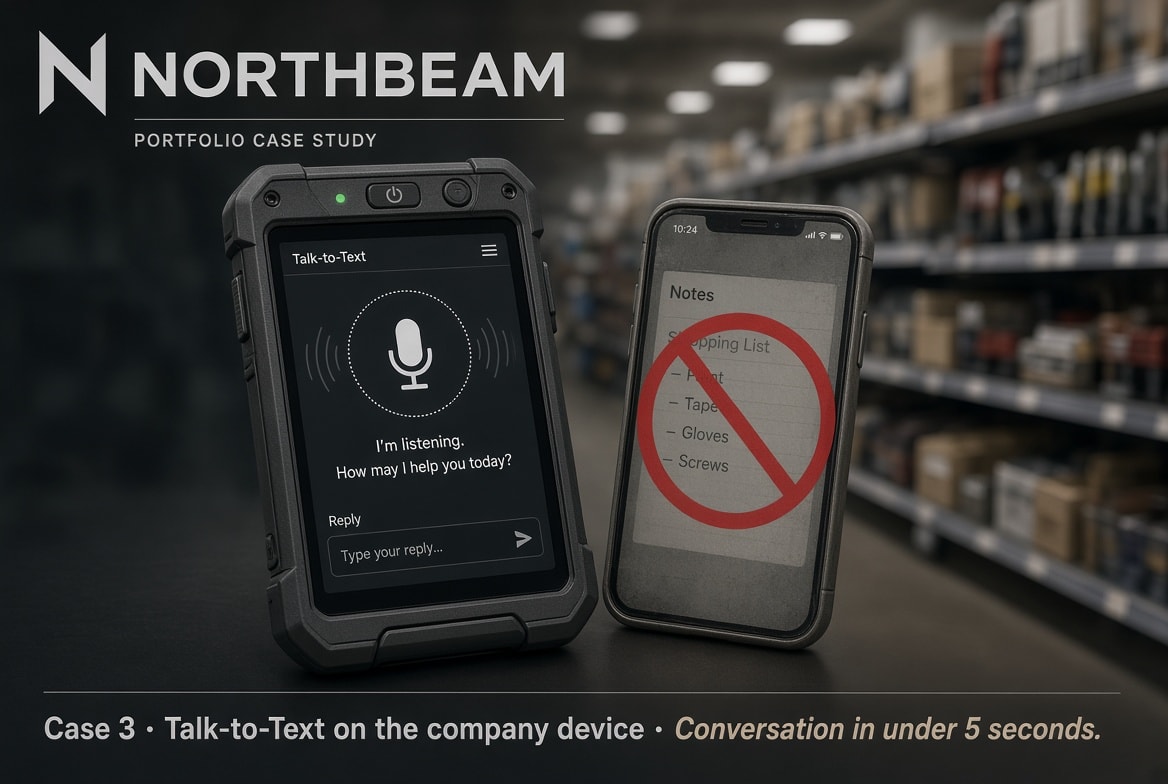
Talk-to-Text on the company-issued handheld device. The risk was legal and compliance: associates had been using apps on private phones to talk to customers at work.
The Challenge
A deaf or hard-of-hearing associate is on the floor to help a customer and cannot get a conversation started.
Accessibility requirements are in play. Visual context already existed—vests and a sign-language badge for about 2,000 associates. That tells the customer why speech is hard. It doesn't let the associate sell.
Workarounds added friction: whiteboard back-and-forth, finding a live ASL interpreter, lip reading (the project board states customers assume it works; it is ineffective 70% of the time), or handing the customer a personal phone and a consumer app.
That last path was the risk I had to remove. Customer conversation on a private device is a legal and compliance problem, not only an accessibility gap.
The Approach
I designed the onboarding and tutorial copy, the listening prompt, the FAB label, the settings labels, error and empty states and the language for the 5-second OKR.
Killed: keep using personal phones (that's the compliance problem). Killed as the channel: interpreter, whiteboard, and badge only.
Shipped: Talk-to-Text on the company-issued handheld device, one tap from the work screen, plus reverse use when the customer is deaf or hard-of-hearing.
Copy in the flow:
- Settings → Accessibility → Talk-to-Text, with Font Size and Help & Tutorial beside it
- Persistent FAB: Talk to Text
- Listening: I'm listening. How may I help you today?
- Reply: Type your reply
- Location context: You Are Here on the store map
That listening line is the OKR in copy: the associate opens the tool and the customer can speak immediately.
The Result
User research showed associates could get the conversation going in store with customers in under 5 seconds—the OKR, hit in practice.
The channel lives on the company-issued handheld device. Associates no longer hand customers a personal phone to communicate. The same flow works in reverse for deaf or hard-of-hearing customers.